
How to Choose Sunscreen Lotion for Hiking and Camping

Quick Summary
For hiking and camping, choose a broad-spectrum sunscreen lotion with SPF 30 or SPF 50 that is sweat or water resistant, and pick mineral or chemical based on your skin. Reapply about every two hours and sooner after heavy sweating, so pack roughly four ounces per person per exposed day.
- Choose a broad-spectrum SPF 30 or SPF 50 for most outdoor trips.
- Mineral formulas suit sensitive skin and sweaty days, while chemical ones usually feel lighter.
- Trust the labeled water resistance duration over marketing phrases like water resistant.
- Reapply every two hours during outdoor exposure and sooner after heavy sweating.
- Plan about four ounces per person per exposed day, with a small face bottle in a hip-belt pocket.
Table of Contents
- Why Hiking and Camping Sunscreen Needs Different Criteria
- Choosing SPF and Broad-Spectrum Protection for Outdoor Trips
- Mineral Versus Chemical Formulas: Which Suits Trail Use
- Best Face Sunscreen for Hiking and Ultralight Backpacking Packs
- Water and Sweat Resistance: What the Label Really Means
- How Often to Reapply Sunscreen Outdoors and How Much to Pack
- Pairing Sunscreen Lotion With Your Trip: Your Next Step
- Frequently Asked Questions
Why Hiking and Camping Sunscreen Needs Different Criteria
Last Updated: November 5, 2026
Most sunscreens are built for a beach chair or a commute, not a ten-mile trail. Hiking and camping put your skin under different pressure: more sweat, more hours outside, reflected light off rock and water, and often no shade. The lotion that works fine at the pool can fail you by the second mile.
That is why choosing sunscreen lotion for hiking and camping deserves its own approach. Here is what changes when you head into the backcountry.

- Sweat builds up fast. Climbing in heat means a steady drip, and cheap formulas slide right off.
- Exposure runs longer. A full day on a trail can mean four to six hours of direct sun.
- Light bounces. Granite, sand, snow, and water all reflect UV back up at your face, ears, and neck.
- Packing space is tight. Every ounce counts, so bulky bottles and aerosol cans are a poor fit.
A common mistake is grabbing the same bottle you use at home. It may be perfectly good, but it was not designed for these conditions. Start by matching the product to the trip, not the other way around.
Choosing SPF and Broad-Spectrum Protection for Outdoor Trips
For most outdoor trips, choose a broad-spectrum SPF 30 or SPF 50 sunscreen. Broad-spectrum means the product guards against both UVA and UVB rays, which are the two types that reach the ground.
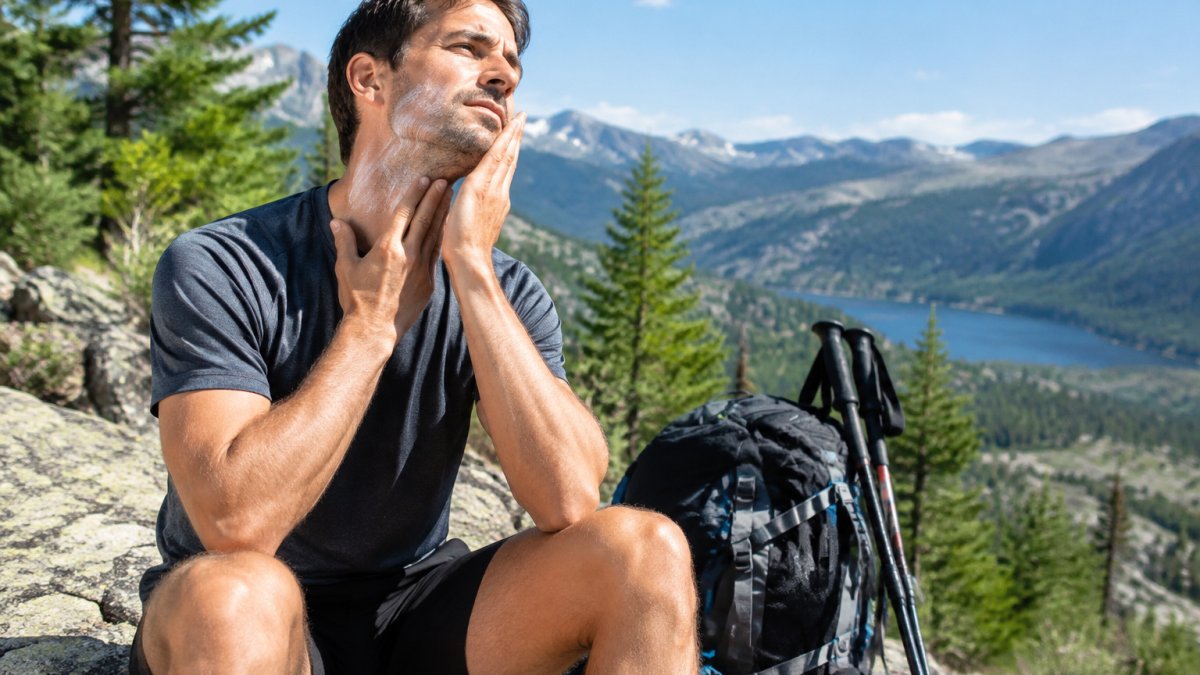
SPF measures protection against UVB rays, the ones mainly responsible for sunburn (the FDA). UVA rays penetrate deeper and contribute to aging and skin damage, so broad-spectrum labeling matters just as much.
Check the Drug Facts panel on the bottle rather than relying on front-of-pack marketing.
Here is how SPF levels usually break down:
| SPF Level | Best For | Trade-Off |
|---|---|---|
| SPF 30 | Shorter hikes, shaded trails | Lighter feel, reapply more often |
| SPF 50 | Open terrain, snow, high sun | Slightly heavier, the strongest common choice |
Watch out: SPF 50 does not mean you can skip reapplication. Sweat and friction wear off any formula, so the number on the label only holds if you keep the layer intact.
Mineral Versus Chemical Formulas: Which Suits Trail Use
Mineral sunscreens use zinc oxide or titanium dioxide to sit on the skin and reflect UV. Chemical sunscreens absorb UV and convert it into heat. Both work, but they behave differently on the trail.
Mineral formulas tend to suit sensitive skin and sweaty days, since they do not rely on absorption. Chemical formulas usually feel lighter and rub in more easily. Many hikers find a mineral lotion stays put better under a pack strap, while others prefer the smoother finish of a chemical one.
Zinc oxide is the mineral most often recommended for sensitive skin. If you have reactive skin, test a small patch a day before a long trip.
Best for: Hikers with sensitive skin or those who sweat heavily and want a formula that stays on. Skip if: You hate the feel of a thicker, whiter-tinted lotion on your face.
Best Face Sunscreen for Hiking and Ultralight Backpacking Packs
If you carry a light pack, your sunscreen needs to earn its weight. A compact, non-greasy face lotion in a small bottle is the practical pick. Look for something that absorbs quickly so it does not pick up dust or dirt from your hands at the trailhead.
Men who want a sunscreen that fits a minimalist pack should consider the Men's SPF 50 Sunscreen Lotion. It is a lightweight daily SPF that rubs in easily and is water and sweat resistant, which suits a trail routine.
For a Woodsman option, see the Woodsman SPF 30 if you prefer a lower SPF for shaded routes.
Water and Sweat Resistance: What the Label Really Means
"Water resistant" is not the same as waterproof. Check the label for the stated water resistance duration.
Here is what matters on a hike:
- A label showing 40 minutes means you should reapply sooner on a hot, sweaty climb.
- An 80-minute claim gives you more buffer, but it still does not replace reapplication.
- Sweat resistance and water resistance are tested differently, so read the claim closely.
Trust the labeled duration more than any marketing phrase.
How Often to Reapply Sunscreen Outdoors and How Much to Pack
Reapply every two hours during outdoor exposure, and sooner after heavy sweating, swimming, or towel drying. That is the standard guidance from dermatology and public health groups, and it holds for camping as much as hiking. The harder question is how much lotion that schedule actually requires, because most hikers either under-pack and run out on day two or carry a full beach bottle they never finish.
Start with the application amount. Full-body coverage takes about one ounce, roughly a shot glass (the American Academy of Dermatology). Face, ears, and neck alone take closer to a nickel-sized dollop, but on a trail you are also exposing arms, hands, and the back of your neck, so plan on the full ounce for any exposed-skin day.
Then build a per-person, per-day estimate:
- Count your sun-exposed hours. A six-hour hike with a midday start is roughly three application windows at the two-hour rule.
- Multiply by one ounce per full-body application. That is about three ounces per person per day on a long exposed hike.
- Add a 30 percent buffer for spills, sweat loss, and missed spots. Round up to four ounces per person per day for planning.
- For a weekend trip, that is about eight ounces per person; for a five-day backpacking trip, plan on roughly 20 ounces per person.
A common pattern is to carry one small face bottle (around two to three ounces) in a hip-belt pocket for reapplication and keep the bulk supply at camp. That keeps the weight off your shoulders while ensuring you never dig through a packed bear canister for lotion mid-climb.
Watch out: a one-ounce bottle is not a full day of coverage for two people. If you are splitting product with a partner, double the estimate before you leave the trailhead.
Store your bottle out of direct heat. A lotion left on a hot dashboard or in a sealed tent can separate and lose effectiveness, and a bottle that has been baked in a car all afternoon may not spread evenly when you need it.
Pairing Sunscreen Lotion With Your Trip: Your Next Step
Sunscreen works best as part of a system, and on a trail the system includes how you apply it, not just what you carry. Pair lotion with a wide-brim hat, sunglasses, and a long-sleeve sun shirt on exposed days. Clothing covers the areas lotion misses, and it cuts down how much product you need.
Application on the trail is where most routines break down. Your hands are dirty, your face is sweaty, and the spots that burn first are the ones you cannot see. A workable sequence:
- Start with clean-ish hands. If you have been handling food or grabbing rocks, wipe your palms on your shirt or rinse with a few ounces from your water bottle before you open the lotion. Grit in a face application is the fastest way to hate your sunscreen.
- Do the face, ears, and neck first. These are the highest-exposure, lowest-coverage areas. Use a small dollop, dot it across forehead, nose, cheeks, and chin, then blend up over the ears and down the back of the neck.
- Cover the scalp and lips. A lotion works on a part line or a thinning crown, but a lip balm with SPF is the better tool for lips. Reapply both at every stop.
- Hands and the back of the neck are the missed spots. The backs of your hands take sun all day on trekking poles, and the back of your neck is exposed whenever you look up. Ask a partner to hit your upper back and shoulders if your shirt comes off.
- Reapply at a scheduled break, not when you feel burned. Tie reapplication to a snack or water stop so it actually happens.
Watch out: applying lotion over a layer of sweat or dust can ball up and leave bare patches. Wipe the area first, then reapply, and give it a minute to set before you put a pack strap back over your shoulder.
Before your next outing, run through this short checklist:
- Choose broad-spectrum SPF 30 or SPF 50
- Pick mineral or chemical based on your skin
- Confirm the water resistance time on the label
- Pack enough for every two-hour reapplication (roughly four ounces per person per exposed day)
- Carry a small face bottle in a hip-belt pocket and the bulk supply at camp
- Test a small patch if your skin is sensitive
Once you have a lotion that fits your trip, bring it along, reapply on schedule, and enjoy the day.
Frequently Asked Questions
What is the best sunblock for hiking?
For hiking, look for a broad-spectrum SPF 50 lotion that is labeled water and sweat resistant and rubs in without leaving a white cast. SLAM's SPF 50 Sunscreen Lotion, priced at $17.99, is built around that combination and comes in Unscented, MysteryMan and GentleMan versions. Pick the scent you will actually wear, since a sunscreen you dislike is one you will skip. Test it on a short walk before a long trip so you know how it feels when you sweat.
Should I use SPF 30 or 50 for hiking?
SPF 50 is the better choice for long days outdoors, especially at elevation or around snow, sand and water where reflected sunlight adds to your exposure. SPF 30 blocks a comparable share of UVB rays in everyday conditions, but the extra margin from SPF 50 matters when you are sweating and reapplying less often. Whichever SPF you choose, make sure it is broad-spectrum so it covers both UVA and UVB rays.
How often should you reapply sunscreen while hiking?
Reapply at least every two hours, and sooner if you have been sweating heavily, wiping your face or swimming. SLAM is labeled water and sweat resistant for 80 minutes, so treat that as the point at which protection can start to drop rather than a safe window. Carry the lotion in a small pocket or hip pack so reapplying at a rest stop takes less than a minute.
How much sunscreen should you pack for a backpacking trip?
A common rule is about one ounce, roughly a shot glass full, to cover the body for a single application. Multiply that by how many applications you expect per day, then by the number of days, and add a buffer of about 20 percent for spills and heavy sweating. For a four-day trip with two applications per day, that works out to about 10 ounces, so pack a larger tube or two smaller ones.
